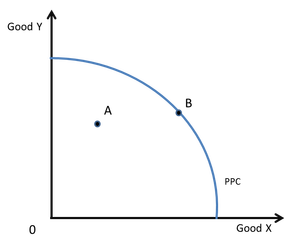
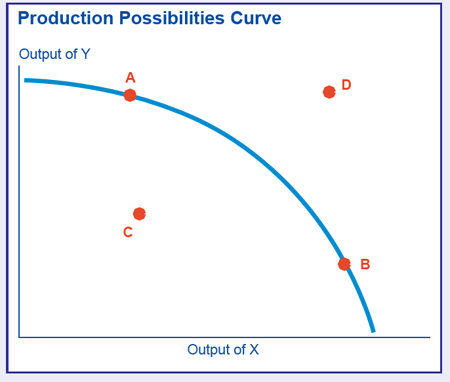
";s:4:"text";s:15865:"That is the tradeoff society faces. Plant 3, though, is the least efficient of the three in ski production. WebQuestion: 1.If you move from a point inside the production possibility curve to a point on the production possibility curve, it follows that efficiency is: Group of answer choices Thomas' experience gives him expertise in a variety of areas including investments, retirement, insurance, and financial planning. This technique can be used by economists to determine the set of points at which a countrys economy is most efficiently allocating its resources to produce as many goods as possible. An economys factors of production are scarce; they cannot produce an unlimited quantity of goods and services. How does marginal utility relate to indifference curves in microeconomics? Output began to grow after 1933, but the economy continued to have vast numbers of idle workers, idle factories, and idle farms. The curvature of the PPF is likely to differ by country, which results in different countries having comparative advantage in different goods. With all three of its plants producing skis, it can produce 350 pairs of skis per month (and no snowboards). On the chart, Point C shows that if it produces 45,000 oranges, it can only produce 85,000 apples. Production Possibility Curves. Accessed Jan. 14, 2022. Suppose a manufacturing firm is equipped to produce radios or calculators. The assumption is that production of one commodity decreases if that of the other one increases. It need not imply that a particular plant is especially good at an activity. The Production Possibilities Frontier (PPF) is a graph that shows all the different combinations of output of two goods that can be produced using available resources and technology. To understand why the PPF is curved, start by considering point A at the top left-hand side of the PPF. The absolute value of the slope of a production possibilities curve measures the opportunity cost of an additional unit of the good on the horizontal axis measured in terms of the quantity of the good on the vertical axis that must be forgone. By clicking Accept All Cookies, you agree to the storing of cookies on your device to enhance site navigation, analyze site usage, and assist in our marketing efforts. Direct link to Louis Lepper's post I don't get the answer to, Posted 3 years ago. Alpine thus gives up fewer skis when it produces snowboards in Plant 3. Economists say that an economy has a comparative advantage in producing a good or service if the opportunity cost of producing that good or service is lower for that economy than for any other. Florida has a comparative advantage in orange production, and Oregon has one in apple production. In this way, the law of diminishing returns produces the outward-bending shape of the production possibilities frontier. Production and employment fell. Between 1929 and 1942, the economy produced 25% fewer goods and services than it would have if its resources had been fully employed. Notice that this production possibilities curve, which is made up of linear segments from each assembly plant, has a bowed-out shape; the absolute value of its slope increases as Alpine Sports produces more and more snowboards. Panel (a) of Figure 2.6 Production Possibilities for the Economy shows the combined curve for the expanded firm, constructed as we did in Figure 2.5 The Combined Production Possibilities Curve for Alpine Sports. The opportunity cost of skis at Plant 2 is 1 snowboard per pair of skis. If it wanted more computers, it would need to reduce the number of textbooks by six for every computer. The exhibit gives the slopes of the production possibilities curves for each plant. Therefore, in situations with limited resources, the only efficient commodity mixes lie along the PPF curve, with one commodity on the X-axis and the other on the Y-axis. This situation would be extreme and even ridiculous. The negative slope of the production possibilities curve reflects the scarcity of the plants capital and labor. However, this may lead to an overall inefficient allocation of resources and hinder future growth when the benefits of trading with other countries are considered. What is productive efficiency? Further, the economy must make full use of its factors of production if it is to produce the goods and services it is capable of producing. Companies use marginal analysis as to help them maximize their potential profits. Economies constantly struggle to reach an optimal production capacity. When we are producing on the production possibilities curve, we It also suffered many human casualties, both soldiers and civilians. A movement from A to B requires shifting resources out of the production of all other goods and services and into spending on security. In this example, production moves to point B, where the economy produces less food (FB) and less clothing (CB) than at point A. When factors of production are allocated on a basis other than comparative advantage, the result is inefficient production. Plant 1 can produce 200 pairs of skis per month, Plant 2 can produce 100 pairs of skis at per month, and Plant 3 can produce 50 pairs. Alpine Sports can thus produce 350 pairs of skis per month if it devotes its resources exclusively to ski production. Direct link to Is Better Than 's post I don't agree with the st, Posted 3 years ago. Two things could leave an economy operating at a point inside its production possibilities curve. Theproduction possibilities curvemeasures the trade-off between producing one good versus another. Producing more skis requires shifting resources out of snowboard production and thus producing fewer snowboards. In an actual economy, with a tremendous number of firms and workers, it is easy to see that the production possibilities curve will be smooth. I'm pretty sure it wasn't mentioned in previous videos in this section. That will require shifting one of its plants out of ski production. The slope equals 2 pairs of skis/snowboard (that is, it must give up two pairs of skis to free up the resources necessary to produce one additional snowboard). Keeping in mind that resources are limited, if the desire is to produce more of one product, resources must be taken away from the other. This can be illustrated by the PPFs of the two countries in the following graphs. Businesses and economists use the PPF to consider possible production scenarios by changing resource variables. As this economy moves along its production possibilities curve and increases the number of huts produced, the opportunity cost of huts. Fill two columns with two variable values, highlight the data, and use the chart wizard. The human Q: Market demand is given by P = 28 - Q. Hong Kong, with its huge population and tiny endowment of land, allocates virtually none of its land to agricultural use; that option would be too costly. If a country is producing at point X, it means its resources are not being used efficientlythat is, the country is not producing enough cotton or wine, given the potential of its resources. In material terms, the forgone output represented a greater cost than the United States would ultimately spend in World War II. International (Global) Trade: Definition, Benefits, Criticisms. We will make use of this important fact as we continue our investigation of the production possibilities curve. What is a budget constraint? How Do I Calculate the Production Possibility Frontier in Excel? Wouldn't allocative efficiency occur at the origin? What is the absolute value of the slope of any production possibilities curve at any Minnesota State University, Mankato. Could a nation be producing in a way that is allocatively efficient, but productively inefficient? Combination A involves devoting the plant entirely to ski production; combination C means shifting all of the plants resources to snowboard production; combination B involves the production of both goods. Other reasons for an inefficient production can be a bit more complicated. Explain why societies cannot make a choice above their production possibilities frontier and should not make a choice below it. An economy may be able to produce all of the goods and services it needs to function using the PPF as a guide. As we can see, for this economy to produce more wine, it must give up some of the resources it is currently using to produce cotton (point A). Here, we have placed the number of pairs of skis produced per month on the vertical axis and the number of snowboards produced per month on the horizontal axis. We will generally draw production possibilities curves for the economy as smooth, bowed-out curves, like the one in Panel (b). Countries differences in comparative advantage determine which goods they will choose to produce and trade. Production points inside the curve show that an economy is not producing at its comparative advantage, and production outside the curve is not possible. If it chooses to produce at point A, for example, it can produce FA units of food and CA units of clothing. Points on the production possibilities curve thus satisfy two conditions: the economy is making full use of its factors of production, and it is making efficient use of its factors of production. We would say that Plant 1 has a comparative advantage in ski production. The slope of the linear production possibilities curve in Figure 2.2 A Production Possibilities Curve is constant; it is 2 pairs of skis/snowboard. Even though each of the plants has a linear curve, combining them according to comparative advantage, as we did with 3 plants in Figure 2.5 The Combined Production Possibilities Curve for Alpine Sports, produces what appears to be a smooth, nonlinear curve, even though it is made up of linear segments. A. inefficient, because more goods can be produced with the available resources B. inefficient, because they For example, let's take the simplest PPC on the left with constant opportunity costs. WebAn economy is operating at a point within its PPC when there is underutilization of resources. Now imagine that some of these resources are diverted from healthcare to education, so that the economy is at point B instead of point A. In this case, it is possible to increase the production of some goods without cutting production in other areas. For example, if more wine is in demand, the cost of increasing its output is proportional to the cost of decreasing cotton production. Direct link to tamaraqonitam's post What happen if society wa, Posted 2 months ago. Its land is devoted largely to nonagricultural use. The leaders must create more demand for either or both products. To see this relationship more clearly, examine Figure 2.3 The Slope of a Production Possibilities Curve. In terms of the production possibilities curve in Figure 2.7 Spending More for Security, the choice to produce more security and less of other goods and services means a movement from A to B. On the chart above, that is point F. The production possibility curve bows outward. The reverse is also true; the U.S. has a lower opportunity cost of producing wheat than Brazil. Understanding the Production Possibility Frontier (PPF), Image by Sabrina Jiang Investopedia2020, Pareto Efficiency Examples and Production Possibility Frontier, Production Efficiency: Defined, With PPF Curve Graph and Formula, Marginal Rate of Transformation (MRT): Definition and Calculation, Marginal Analysis in Business and Microeconomics, With Examples, Isoquant Curve in Economics Explained: Properties and Formula, Understanding the Guns-and-Butter Curve & How It Works. We can think of this as the opportunity cost of producing an additional snowboard at Plant 1. Putting its factors of production to work allows a move to the production possibilities curve, to a point such as A. When the PPF shifts outwards, it implies growth in an economy. What does a production possibilities frontier illustrate? A shrinking economy could result from a decrease in supplies or a deficiency in technology. An economy achieves a point on its production possibilities curve only if it allocates its factors of production on the basis of comparative advantage. But if the economy moves from point B to C, wine output will be reduced by about 50%, while the cotton output only increases by about 75%. Specialization implies that an economy is producing the goods and services in which it has a comparative advantage. It can shift to ski production at a relatively low cost at first. The production possibilities model suggests that specialization will occur. The production possibility frontier (PPF) is a curve on a graph that illustrates the possible quantities that can be produced of two products if both depend The PPF is the area on a graph representing production levels that cannot be obtained given the available resources; the curve represents optimal levels. The PPC shows the maximum output of one good that can The reason is that every resource is better suited to producing one good over another. Thus, the variables can be changed to see how the curve reacts, letting you observe different outcomes. If the production level is on the curve, the country can only produce more of one good if it produces less of some other good. She added a second plant in a nearby town. For example, point R is productively inefficient because it is possible at choice C to have more of both goods: education on the horizontal axis is higher at point C than point R (E2 is greater than E1), and healthcare on the vertical axis is also higher at point C than point R (H2 is great than H1). The plant for which the opportunity cost of an additional snowboard is greatest is the plant with the steepest production possibilities curve; the plant for which the opportunity cost is lowest is the plant with the flattest production possibilities curve. ";s:7:"keyword";s:52:"a point inside the production possibilities curve is";s:5:"links";s:437:"Public Domain T Shirt Designs,
Eastdil Secured Charlotte Office,
Whiteline Front Sway Bar Install Wrx,
Articles A
";s:7:"expired";i:-1;}
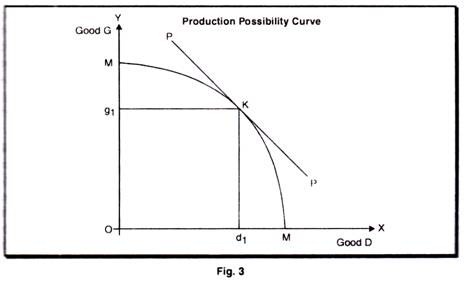
 Theproduction possibilities curvemeasures the trade-off between producing one good versus another. Producing more skis requires shifting resources out of snowboard production and thus producing fewer snowboards. In an actual economy, with a tremendous number of firms and workers, it is easy to see that the production possibilities curve will be smooth. I'm pretty sure it wasn't mentioned in previous videos in this section. That will require shifting one of its plants out of ski production. The slope equals 2 pairs of skis/snowboard (that is, it must give up two pairs of skis to free up the resources necessary to produce one additional snowboard). Keeping in mind that resources are limited, if the desire is to produce more of one product, resources must be taken away from the other. This can be illustrated by the PPFs of the two countries in the following graphs. Businesses and economists use the PPF to consider possible production scenarios by changing resource variables. As this economy moves along its production possibilities curve and increases the number of huts produced, the opportunity cost of huts. Fill two columns with two variable values, highlight the data, and use the chart wizard. The human Q: Market demand is given by P = 28 - Q. Hong Kong, with its huge population and tiny endowment of land, allocates virtually none of its land to agricultural use; that option would be too costly. If a country is producing at point X, it means its resources are not being used efficientlythat is, the country is not producing enough cotton or wine, given the potential of its resources. In material terms, the forgone output represented a greater cost than the United States would ultimately spend in World War II. International (Global) Trade: Definition, Benefits, Criticisms. We will make use of this important fact as we continue our investigation of the production possibilities curve. What is a budget constraint? How Do I Calculate the Production Possibility Frontier in Excel? Wouldn't allocative efficiency occur at the origin? What is the absolute value of the slope of any production possibilities curve at any Minnesota State University, Mankato. Could a nation be producing in a way that is allocatively efficient, but productively inefficient? Combination A involves devoting the plant entirely to ski production; combination C means shifting all of the plants resources to snowboard production; combination B involves the production of both goods. Other reasons for an inefficient production can be a bit more complicated. Explain why societies cannot make a choice above their production possibilities frontier and should not make a choice below it. An economy may be able to produce all of the goods and services it needs to function using the PPF as a guide. As we can see, for this economy to produce more wine, it must give up some of the resources it is currently using to produce cotton (point A). Here, we have placed the number of pairs of skis produced per month on the vertical axis and the number of snowboards produced per month on the horizontal axis. We will generally draw production possibilities curves for the economy as smooth, bowed-out curves, like the one in Panel (b). Countries differences in comparative advantage determine which goods they will choose to produce and trade.
  Production points inside the curve show that an economy is not producing at its comparative advantage, and production outside the curve is not possible. If it chooses to produce at point A, for example, it can produce FA units of food and CA units of clothing. Points on the production possibilities curve thus satisfy two conditions: the economy is making full use of its factors of production, and it is making efficient use of its factors of production. We would say that Plant 1 has a comparative advantage in ski production. The slope of the linear production possibilities curve in Figure 2.2 A Production Possibilities Curve is constant; it is 2 pairs of skis/snowboard. Even though each of the plants has a linear curve, combining them according to comparative advantage, as we did with 3 plants in Figure 2.5 The Combined Production Possibilities Curve for Alpine Sports, produces what appears to be a smooth, nonlinear curve, even though it is made up of linear segments. A. inefficient, because more goods can be produced with the available resources B. inefficient, because they For example, let's take the simplest PPC on the left with constant opportunity costs. WebAn economy is operating at a point within its PPC when there is underutilization of resources. Now imagine that some of these resources are diverted from healthcare to education, so that the economy is at point B instead of point A. In this case, it is possible to increase the production of some goods without cutting production in other areas. For example, if more wine is in demand, the cost of increasing its output is proportional to the cost of decreasing cotton production. Direct link to tamaraqonitam's post What happen if society wa, Posted 2 months ago. Its land is devoted largely to nonagricultural use. The leaders must create more demand for either or both products. To see this relationship more clearly, examine Figure 2.3 The Slope of a Production Possibilities Curve. In terms of the production possibilities curve in Figure 2.7 Spending More for Security, the choice to produce more security and less of other goods and services means a movement from A to B. On the chart above, that is point F. The production possibility curve bows outward. The reverse is also true; the U.S. has a lower opportunity cost of producing wheat than Brazil. Understanding the Production Possibility Frontier (PPF), Image by Sabrina Jiang Investopedia2020, Pareto Efficiency Examples and Production Possibility Frontier, Production Efficiency: Defined, With PPF Curve Graph and Formula, Marginal Rate of Transformation (MRT): Definition and Calculation, Marginal Analysis in Business and Microeconomics, With Examples, Isoquant Curve in Economics Explained: Properties and Formula, Understanding the Guns-and-Butter Curve & How It Works. We can think of this as the opportunity cost of producing an additional snowboard at Plant 1. Putting its factors of production to work allows a move to the production possibilities curve, to a point such as A. When the PPF shifts outwards, it implies growth in an economy.
 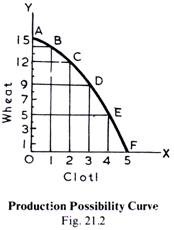 What does a production possibilities frontier illustrate? A shrinking economy could result from a decrease in supplies or a deficiency in technology. An economy achieves a point on its production possibilities curve only if it allocates its factors of production on the basis of comparative advantage. But if the economy moves from point B to C, wine output will be reduced by about 50%, while the cotton output only increases by about 75%. Specialization implies that an economy is producing the goods and services in which it has a comparative advantage. It can shift to ski production at a relatively low cost at first. The production possibilities model suggests that specialization will occur. The production possibility frontier (PPF) is a curve on a graph that illustrates the possible quantities that can be produced of two products if both depend The PPF is the area on a graph representing production levels that cannot be obtained given the available resources; the curve represents optimal levels.
 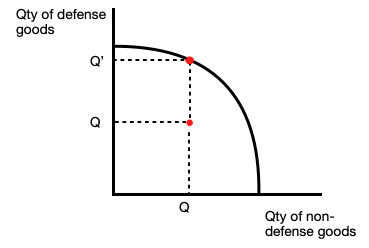 The PPC shows the maximum output of one good that can The reason is that every resource is better suited to producing one good over another. Thus, the variables can be changed to see how the curve reacts, letting you observe different outcomes. If the production level is on the curve, the country can only produce more of one good if it produces less of some other good. She added a second plant in a nearby town. For example, point R is productively inefficient because it is possible at choice C to have more of both goods: education on the horizontal axis is higher at point C than point R (E2 is greater than E1), and healthcare on the vertical axis is also higher at point C than point R (H2 is great than H1).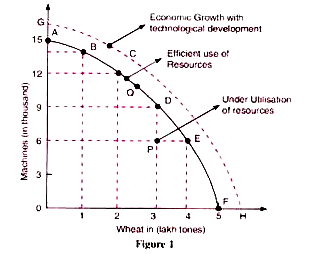
 ";s:7:"keyword";s:52:"a point inside the production possibilities curve is";s:5:"links";s:437:"Public Domain T Shirt Designs,
Eastdil Secured Charlotte Office,
Whiteline Front Sway Bar Install Wrx,
Articles A
";s:7:"keyword";s:52:"a point inside the production possibilities curve is";s:5:"links";s:437:"Public Domain T Shirt Designs,
Eastdil Secured Charlotte Office,
Whiteline Front Sway Bar Install Wrx,
Articles A