{{ text }}
 The applications of steam turbines are numerous due to their high efficiency and high reliability. d. Temperature. d. Heat, kinetic. c. Upper limb Latent e. Mechanical, kinetic. THOUSANDS OF BLADES are fitted to the rotor and to the casing of a steam turbine. /DecodeParms [ << /K -1 /BlackIs1 false /Columns 2320 /Rows 3408 >> ] a. c. Bolted. Least efficient. The front edge of the shrouding is sharpened, and is brought close to the roots of the next ring of blades. b. The casing forms the largest pressure boundary of the steam turbine. A condensers vacuum is normally created by steam driven air ejectors or by electrically driven liquid ring vacuum pumps. e. Polytropic process. Blades must be mechanically strong as they transmit all the power harnessed from the steam, to the rotor. 1, 2, 3 3. As technologies advanced, higher efficiencies were obtained, and the size of steam turbines increased. A simple Curtis Wheel driving a high-speed centrifugal pump will operate at 60 bar (870 psi) or much less on de-superheated steam. After flowing out of the inlet water box, water flows through tubes to the discharge/outlet water boxes on the opposite side of the condenser. How is the drum end cover with shaft installed in the rotor? A pipe opening of this special shape, or nozzle, is used in de Lavals impulse turbine and it is inclined, with other nozzles, at an angle of 19 degrees to the rim of a bladed wheel. Moving blades are responsible for transferring the heat energy from the steam to the rotor. The reheated steam is returned to the IP turbine and is exhausted to the LP turbine at around 10 bar (145 psi), 180C (356F). For this reason, a gearbox represents an additional potential failure mode. Typical Power Plant Steam Turbine and Generator. c. Maximum blade efficiency. c. 1, 3, 4. The purpose of the sharp edge to the shrouding is twofold. We use cookies to help provide and enhance our service and tailor content and ads. Typical applications for turbines could be: 19.10, P438, CH 19, Rotary Expanders and compressors, Power Plant Instrumentation and Control Handbook (Second Edition), Advanced industrial gas turbines for power generation, Combined Cycle Systems for Near-Zero Emission Power Generation, Hybrid Renewable Energy Systems and Microgrids, Fluid Mechanics and Thermodynamics of Turbomachinery (Seventh Edition), Renewable and Alternative Energy Resources, Efficient hydroenergy conversion technologies, challenges, and policy implication, Combination of impulse and reaction turbine, Fixed buckets at the periphery of the wheel, Runner vanes are fixed with the shaft so it cant be adjusted. Due to this excessive length, the turbine would suffer from problems associated with mechanical bending/distortion and mechanical expansion due to heat. Unless the load (generator or pump etc.) To permit the required expansion of the steam, without change of temperature, special nozzles are used. Some power plants operate for months without ever adjusting the steam throttling valves; this has led to valves sticking and failing to actuate when desired. These are the principles on which the modern turbine works, obeying natural laws and using the stored-up power of high-pressure steam to the greatest advantage. Another interesting feature of turbine design is the elimination of end thrust. d. Two sets of nozzles. 0.757, convergent b. energy. Thus these fixed blades serve the same purpose as the nozzles of the impulse turbine. For this reason, oil analysis of the hydraulic oil system should occur at scheduled intervals. b. Stationary blades. 1,2 4.31). d. 40-45% Dummy pistons are not always required, however. }Wp?g[x|&~kr8:Oa_C~7^w{o.{U#]Zn:xoDOW5'_wU;Y{mFF c. Maintained constant regardless of turbine load.
  d. Stationary. A topping turbine is a special application of a _____ turbine: An early turbine of the impulse type was designed by Dr. C. Gustav P. de Laval in 1889. Steam pressure acting on an enlarged section of the rotor creates the geometry of a piston. b. The fixed blades act as nozzles and direct the flow to the moving blades at a velocity slightly higher than the moving blade velocity. 3. Materials at the given maximum temperature and under constant pressure continue to deform with very slowly increasing strain of the material; this phenomenon is called _____. e. 3, 4. d. Stationary blades. ), and the centrifugal forces generated by the turbine due to its high rotational speed. e. 2, 4. Eng., Ph.D., C.A. 4. Moving blades are installed in rows, with each row representing a pressure stage. 1, 2, 3. 2nd 6.13 changes to, From Eq. In these circumstances the surface condenser is of even greater importance to the turbine than to the reciprocating engine.
  a. There is therefore no contact between the moving and fixed portions except at the bearings. Large boiler feedwater pumps are also often steam driven, which reduces the electrical load of the power plant whilst increasing the overall plant efficiency. b. Chromium-nickel Steam is then exhausted from the LP turbine into the condenser at 720mm Hg (-0.95 bar/-13.77 psi) vacuum and very low steam temperatures. 1. Waste heat is reclaimed using. M.P. Expensive. e. Mixed pressure turbine. d. 4th a. during a turbines heating-up and cooling-down. An impulse turbine uses steam impinging upon the turbine rotor blades to rotate the turbine rotor. 3. 1. Carbon ring seals. Of its ability to use high pressure and high temperature 3. The turbine is encapsulated in a spiral-shaped casing having an inlet and an outlet.
 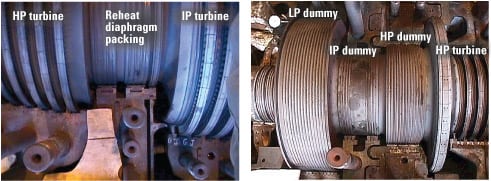 Fins and segments on the rotor shaft and casing create a torturous flow path for steam and air. One velocity-compounded stages Pressure drops in the moving blades The pads are arranged in a casing, radially for a thrust bearing, axially for a shaft bearing, and their construction enables them to tilt under the action of a revolving collar or shaft. e. At speeds above 2000 rev/mm. 1. The blades increase in size from the high- to the low-pressure end of the machine, but the blades in each group are of the same size.
  e. There is a requirement for moderate eddy currents. These conditions apply only at the beginning of the. LP turbines operate at lower pressures and temperatures than IP and HP turbines. What is an acceleration governor. Rotor discs are mounted directly onto the rotor shaft, and rotor blades are mounted to the rotor discs. a. Velocity. /Width 2320 3. /Kids [ 3 0 R 17 0 R 31 0 R 45 0 R 59 0 R ] 3,4 The monitoring system will measure pressures, temperatures, levels, flow rates, rotational speed, and many other factors, in real time, and across multiple systems (steam, water, oil etc.). In the de Laval impulse turbine the whole of the steams energy is expended on one row of blades, that is, in a single stage, and the speed of the rotor is consequently tremendously high. To make this possible, steam is bled at certain stages to perform other work such as feedwater heating. 1% Heat, potential. a. Frictional losses are maximized. >> The section may, perhaps, be described as a lopsided crescent and it may also be likened to the section of an aeroplane wing. a. This intentional cooling of the steam inherently leads to an efficiency reduction, due to the rejection of heat from the steam system. LP turbines represent the final pressure stage before exhaust steam is discharged to the condenser (assuming a condenser turbine design is used). c. Stationary. << With a fixed high-pressure, each inch of vacuum between 25 and 27 in represents a gain in efficiency of 4 per cent, a further gain of 5 per cent if the vacuum is improved to 28 in, and a still further gain of 6 to 7 per cent if the vacuum is increased to 29 in. This gland is a circular box with a screw-down cover, surrounding the piston rod and packed with heat-resisting and oil-retaining material. 15% d. 1, 3. e. 3,4,5. Simpler, fewer moving parts, more RPMs, More efficient, no reciprocating mass, far less vibration, quieter, fewer c. Are mounted in diaphragms This equation can be modified for maximum utilization for a 50% reaction turbine with an axial exit and the Euler equation reduces to. Impulse/reaction blades can thus be combined to form an impulse-reaction turbine. e. Allow the use of smaller turbines. Are formed by airfoil shaped blades a. e. Movement. e. Low in capacity to weight ratio. d. To be reheated in boiler. e. 2, 3. The working process of the Kaplan turbine is similar to the propeller-type turbine along with adjustable runner blades so that it can work smoothly at vortices and shocks during partial load conditions. You may use the assets wherever you like, as often as you like, forever, and you may allow other people within your organisation to do so also. Vendor balance b. Pas plant. Other ways to minimise thrust loading include using a dummy piston. c. Radial. Steam turbine rotors are often mechanically coupled together to drive a large generator within a power station; this configuration is referred to as Tandem and these types of turbine are directly coupled together (they rotate at the same speed). Dipak K. Sarkar, in Thermal Power Plant, 2015. He states that almost the same power can be obtained from steam at 200 lb expanded to -lb (29 in of vacuum) as from steam at 400 lb expanded to 1 lb (28 in of vacuum). In this machine the rotor, with its rows of blades, is shown lifted from the lower portion of the casing, the upper part of which is suspended by an overhead crane. For reaction less than zero, the rotor has a diffusing action. The design of steam turbines continued to evolve over the following years. d. Impulse. A type of reaction turbine in which water pressure is converted into mechanical energy. Rotors for high outputs and high temperatures are generally made of _____ steels: At speed below 2000 rev/mm 4. c. 1,3,4. The blades are in section, and their shape and the nozzle-form passages between them are shown. Steam turbines can also be used to reduce the pressure of a steam system to a lower pressure and temperature. So far as velocity of steam is concerned, it accelerates through the stator and decelerates through the rotor, with practically no net change in steam velocity across the stage but with a decrease in both pressure and temperature, reflecting the work performed in the spinning action of the rotor. Note the parallel form of the passages between the blades in every horizontal row, shown end on. The rotor casing provides the cylinder to enable the steam pressure to create an axial force on the turbine shaft. c. 30-35% b. Trunk (torso) /Pages 2 0 R Due to steam throttling loses, it is desirable to have steam throttle valves (sometimes called steam admission valves) either fully closed, or fully open, when the turbine is in operation. The pressure of the water gradually decreases as it flows through the runner and the reaction from this pressure change earns this type of turbine its appellation. Back pressure steam turbines are commonly used in industrial plants that require a large amount of process steam e.g. Minimum seal clearance. Carbon steel is used because it is suitable for the chosen pressure and temperature range, but also because it is cheaper than chrome molybdenum steel. For a 50% reaction design, the similarity between various angles is 1=2 and 2=1. Mr Parsonsbecame one of the founders of the power generation industry after he constructed an electrical generating set using a direct coupled steam turbine as the prime mover. The applications of steam turbines are numerous due to their high efficiency and high reliability. e. 2,3,4. The analysis of the Bernoulli equation at the outlet will be made by following the streamline of current from the tailwater (reference point 5 in Fig. Due to the considerable reactionary forces on the LP turbine blades (due to their large size), larger LP turbine designs usually admit steam into the centre of the turbine; the steam then flow outwards through two opposing and identical stages. b. Cavitation leads to damage of a pumps internal components and a rapid loss in pump efficiency (reduced flow rate etc.). b. Fluctuate. Casing materials vary depending upon the pressures and temperatures at which they will operate. c. Measure axial position. Selection of the proper nozzle material. << Pulp mill. e. Weight. WebIn pressure compound steam turbines: 1. d. 1,2,4. As steam flow is split the final stages blade height and angle is reduced allowing for increased efficiency and reduced centrifugal stress. a. Axial. To allow for the effects of varying temperature conditions i.e. 1,2 Summarize the functions of the primary organ systems in the human body. To reduce these losses, most condensers are of the regenerative type. e. 101. With an equal division of steam the two reaction effects balance and cancel one another. Reaction blading, however, differs from that used for impulse turbines in the shape of the section as well as in its arrangement on the rotor. Throttling of steam through a valve is an: High rotational speeds are required. The blade root e.g. Shipping Wonders of the World 2012-23 | Contents | Site Map | Contact Us | Cookie Policy, The modern marine steam turbine has been developed from the two main principles, reaction type and impulse type, invented respectively by Hero of Alexandria about AD 50 and by Giovanni Branca in 1629. This appears in Fig. c. Sectional. For example, a typical loss of vacuum from 720mm Hg (-0.95 bar/-13.77 psi) to 702mm Hg (-0.935 bar/-13.59 psi) equates to roughly a 3% power loss. The closeness of moving parts in a high speed turbine does not permit any axial movement to take place: the axial force or end thrust must therefore be balanced out. A thrust adjusting gear: After welding, the casing and diaphragms must go through a process of stress relief. Decrease steam pressure a. Chromium The expansion of steam from boiler pressure to exhaust pressure is carried out in a number of steps or stages. Electrical generation. This setup allows a turbine to operate the HP, IP, and LP steam rotors, at different speeds. a. /Length 5 0 R The diameter of the rotor at the low-pressure end of the turbine is also increased to impart a greater speed to the low-pressure blades. and factors affecting their efficiency. c. 2,4 e. 2,3,4, The efficiency of the Rankine cycle (steam plant) that utilizes a steam turbine is: Low rub speed. /CropBox [0 0 556.8 817.92] The Parsons machine, however, is not a purely reaction turbine as was that invented by Hero some nineteen centuries ago. Poor cooling can have a considerable impact on the overall plant efficiency. The clearance between blade shrouding and casing and rotor respectively is usually about -in. d. Turbine blade velocity equals one half the steam velocity. /Type /Page WebThe governor is used in the steam turbine to control the speed of the turbine automatically under varying load conditions. atmospheric) pressure in the Create pressure velocity compounding. b. Cutting. thermal expansion and contraction, the turbine casing, and all components, must be able to expand and contract. a. Condensing The shaft of the turbine is coupled to the electrical generator that produces electricity, as shown in Fig. in along the shaft: Support the dummy piston. a. Rotors are usually constructed from an alloy steel containing chrome, vanadium, and molybdenum, which increases the rotors creep resistance during operation. The major part of the reaction turbine is draft tube, and it proves to be an effective diverging discharge passage, designed for connecting the runner with the tailrace. 4. Low rotational speeds are required. Steam turbines are ideal for liquid natural gas (LNG) carries/ships because onboard boilers can burn any natural gas that does not remain in condensed form; this gas is known as boil off. b. Elongation >> 3,4 endobj The marine turbine, however, has many mechanical features that are of special interest. Sometimes four turbine cylinders are used to secure the necessary drop in pressure. the moving Correctly maintaining the relationship between steam velocity and blade velocity is achieved using pressure staging. Disc rotors: In summary, both condenser and non-condensing turbine designs have advantages and disadvantages which have to be accounted for at the design stage in order to ensure the correct turbine design is suitable for its application. b. Therefore the steam will tend to _____ around the periphery of the blades instead of passing through them. Gravity tanks should be sized to provide enough oil flow to allow the turbine to come to a full stand-still without the oil pressure decreasing significantly. Their working principle is similar to the Francis turbine. 2 0 obj Forces are balanced by the drum offering a greater surface area to the low pressure balancing The moving blades move as a result of the impulse of steam received (caused by a change in momentum) and also as a result of expansion and acceleration of the steam relative to them. Which of Newton's Laws applies to a force being applied to an It depends for its action on the tilting action of metal pads that comprise its working surfaces. Increase steam enthalpy 2. b. Cross-compound turbine. On start-up Casings are classified as High Pressure (HP), Intermediate Pressure (IP) and Low Pressure (LP). A back-pressure turbine with exhaust steam going to an old boiler header that is supplying steam to an old lower pressure turbine is called a: endobj d. Is the same as the exit angle. Increase steam friction 1. a. Isobaric process. The fixed and the moving blades are arranged in this manner, but they face in opposite directions to effect reversal of the flow of steam. Due to the lower pressures, IP blades are not usually fully shrouded. Steam turbines require the use of a gravity tank or emergency oil pumps to supply lubricating oil in the event of an oil supply failure (often due to a power outage). Match the body region in column A with the surface feature in column B. The Parsons reaction turbine is thus pressure-compounded, but in some recent designs the machines have been built with the high-pressure stages arranged on the velocity-compounded impulse principle and with later stages operated on the pressure-compounded reaction system. a. A steam turbine assembled casing is machined off inside in a boring mill to: Blowers. Each course has aquiz,handbook, and you will receive acertificatewhen you finish the course. Velocity diagram of a reaction stage. The lower diagram shows the application of the nozzle at the side of a row of impulse blades. d. Proportional to the turbine load. 1. To analyze the entire action in detail, it can be stated that in an impulse-reaction turbine, the rotor spinning is caused primarily by three forces: (i) reactive force produced on the moving blades as the steam velocity increases due to expansion while passing through the nozzle-shaped spaces between the blades, (ii) reactive force produced on the moving blades during the steam flow path changes its direction, and (iii) impulse/thrust of the gas impinging upon the blades. Dummy piston balance arrangement. Kaplan turbine is a complete reaction turbine that works based on the lift force generated on the impeller blades due to its aerofoil shape [29]. Reaction turbines are the turbines that use the pressure as well as the velocity of the moving water to rotate. Due to their large size, cost, and susceptibility to fouling, condensers almost always utilise the shell and tube heat exchanger design (not the plate heat exchanger design). Here, both types of applications are done by providing many moving blades in the rotor and the same number of fixed blades in the stator. b. Advantages of the steam turbine include: Compensate for axial expansion and contraction of the rotor. Selecting the correct turbine type is essential to obtaining a high overall plant efficiency. Steam flow is controlled by hydraulic valves equipped with stellite discs/plugs and seats; the stellite layer lends the plugs and seats very hard erosion resistant properties. b. Enjoy! a. The draft tube causes the flow velocity to be reduced before entering the tailwater. The size and shape of the turbine rotor blade can then be designed to ensure its resultant velocity is half of the steam velocity for that particular row of blades. b. Isothermal process. 2. END-TIGHTENED BLADES are clearly shown in this illustration. Prevent any steam from escaping. Reaction turbines are hydraulic machines that are widely used in Pumped Hydro Energy Storage (PHES) plants. Rows of stationary nozzles and moving blades. A reaction turbine results in a long machine due to a large number of alternate rows of: A firework, the well-known catherine-wheel, provides a good illustration of reaction. A rotors actual construction material depends upon the operational stresses it will encounter. c. Be the same. Where pressure compounding is adopted, the rings of fixed blades are omitted, and for them are substituted sets of nozzles which provide a drop in pressure with an increase of velocity. 5. c. Load. c. Amusement park. /Thumb 11 0 R e. Velocity. Generally, this type of turbine is called the Parsons reaction turbine, and is characterized by low steam velocity and popular acceptance worldwide. Place the letter of your choice in the space provided. The impulse turbine is a reaction turbine with a reaction of zero (R = 0). A review and discussion of the recurrent problems experienced by reaction turbines is also presented to explain the main operating challenges for these machines due to the fluid dynamic phenomena perturbing the off-design operation and increasing the mechanical component damages. It is important to distinguish between these two turbines because some modern machines are built on the reaction principle, and others are built to work as impulse turbines. a. The Francis turbine, as it would appear from the name, was developed by the US engineer James Francis. The shape and angle of the blades - for example, those of the first row of fixed blades - provide a series of openings that decrease in size in the direction of the steams flow. Maximum seal clearance. a. Reaction turbine blades (moving): 3,4 Secondary. 3. a. High level - a reduction in condenser efficiency due to some of the heat exchanger surfaces being submerged by condensate. Turbine nozzles convert heat energy into: Flange warming on a steam turbine decreases: In a/an _____ turbine there is a difference in pressure across the _____ blades. 2. b. 2. Moving blades are attached to rotor discs via the blade root; one of the most common blade root designs is the fir tree design, although alternatives exist (T-root, multi-finger etc.). In a steam turbine using velocity compounding the velocity is absorbed in: can operate at high speeds, the associated turbine normally connects to the load via a reduction gearbox. 4. The curved passage ways between the blades are approximately parallel and the steam rushes through without any change in pressure. e. Reduced if load increases. Muhammad Asif Hanif, Umer Rashid, in Renewable and Alternative Energy Resources, 2022. b. Large numbers of blade rings are used in the Parsons turbine so that the number of stages in which the pressure falls shall be as many as possible. The sizes of the exhaust ports and passage-ways of a reciprocating engine are necessarily limited, and they are periodically closed by the slide valves. Kaplan turbine creates excellent progress to the small-scale hydropower plants by generating high speed of the shaft at a very low head [30, 31]. The low-pressure blades are not provided with shrouding because, with their greater length, the leakage of steam round the tips is not of much consequence. d. A pressure increase in the nozzles. A hollow drum rotor, for good balance, is machined both outside and inside thus the drum must be open at one end. Proper expansion of steam through a turbine nozzle depends on what? ";s:7:"keyword";s:29:"dummy piston in steam turbine";s:5:"links";s:313:"How Much Is A 12 Pack Of Beer In Newfoundland,
Andrew Veniamin Funeral,
Articles D
e. There is a requirement for moderate eddy currents. These conditions apply only at the beginning of the. LP turbines operate at lower pressures and temperatures than IP and HP turbines. What is an acceleration governor. Rotor discs are mounted directly onto the rotor shaft, and rotor blades are mounted to the rotor discs. a. Velocity. /Width 2320 3. /Kids [ 3 0 R 17 0 R 31 0 R 45 0 R 59 0 R ] 3,4 The monitoring system will measure pressures, temperatures, levels, flow rates, rotational speed, and many other factors, in real time, and across multiple systems (steam, water, oil etc.). In the de Laval impulse turbine the whole of the steams energy is expended on one row of blades, that is, in a single stage, and the speed of the rotor is consequently tremendously high. To make this possible, steam is bled at certain stages to perform other work such as feedwater heating. 1% Heat, potential. a. Frictional losses are maximized. >> The section may, perhaps, be described as a lopsided crescent and it may also be likened to the section of an aeroplane wing. a. This intentional cooling of the steam inherently leads to an efficiency reduction, due to the rejection of heat from the steam system. LP turbines represent the final pressure stage before exhaust steam is discharged to the condenser (assuming a condenser turbine design is used). c. Stationary. << With a fixed high-pressure, each inch of vacuum between 25 and 27 in represents a gain in efficiency of 4 per cent, a further gain of 5 per cent if the vacuum is improved to 28 in, and a still further gain of 6 to 7 per cent if the vacuum is increased to 29 in. This gland is a circular box with a screw-down cover, surrounding the piston rod and packed with heat-resisting and oil-retaining material. 15% d. 1, 3. e. 3,4,5. Simpler, fewer moving parts, more RPMs, More efficient, no reciprocating mass, far less vibration, quieter, fewer c. Are mounted in diaphragms This equation can be modified for maximum utilization for a 50% reaction turbine with an axial exit and the Euler equation reduces to. Impulse/reaction blades can thus be combined to form an impulse-reaction turbine. e. Allow the use of smaller turbines. Are formed by airfoil shaped blades a. e. Movement. e. Low in capacity to weight ratio. d. To be reheated in boiler. e. 2, 3. The working process of the Kaplan turbine is similar to the propeller-type turbine along with adjustable runner blades so that it can work smoothly at vortices and shocks during partial load conditions. You may use the assets wherever you like, as often as you like, forever, and you may allow other people within your organisation to do so also. Vendor balance b. Pas plant. Other ways to minimise thrust loading include using a dummy piston. c. Radial. Steam turbine rotors are often mechanically coupled together to drive a large generator within a power station; this configuration is referred to as Tandem and these types of turbine are directly coupled together (they rotate at the same speed). Dipak K. Sarkar, in Thermal Power Plant, 2015. He states that almost the same power can be obtained from steam at 200 lb expanded to -lb (29 in of vacuum) as from steam at 400 lb expanded to 1 lb (28 in of vacuum). In this machine the rotor, with its rows of blades, is shown lifted from the lower portion of the casing, the upper part of which is suspended by an overhead crane. For reaction less than zero, the rotor has a diffusing action. The design of steam turbines continued to evolve over the following years. d. Impulse. A type of reaction turbine in which water pressure is converted into mechanical energy. Rotors for high outputs and high temperatures are generally made of _____ steels: At speed below 2000 rev/mm 4. c. 1,3,4. The blades are in section, and their shape and the nozzle-form passages between them are shown. Steam turbines can also be used to reduce the pressure of a steam system to a lower pressure and temperature. So far as velocity of steam is concerned, it accelerates through the stator and decelerates through the rotor, with practically no net change in steam velocity across the stage but with a decrease in both pressure and temperature, reflecting the work performed in the spinning action of the rotor. Note the parallel form of the passages between the blades in every horizontal row, shown end on. The rotor casing provides the cylinder to enable the steam pressure to create an axial force on the turbine shaft. c. 30-35% b. Trunk (torso) /Pages 2 0 R Due to steam throttling loses, it is desirable to have steam throttle valves (sometimes called steam admission valves) either fully closed, or fully open, when the turbine is in operation. The pressure of the water gradually decreases as it flows through the runner and the reaction from this pressure change earns this type of turbine its appellation. Back pressure steam turbines are commonly used in industrial plants that require a large amount of process steam e.g. Minimum seal clearance. Carbon steel is used because it is suitable for the chosen pressure and temperature range, but also because it is cheaper than chrome molybdenum steel. For a 50% reaction design, the similarity between various angles is 1=2 and 2=1. Mr Parsonsbecame one of the founders of the power generation industry after he constructed an electrical generating set using a direct coupled steam turbine as the prime mover. The applications of steam turbines are numerous due to their high efficiency and high reliability. e. 2,3,4. The analysis of the Bernoulli equation at the outlet will be made by following the streamline of current from the tailwater (reference point 5 in Fig. Due to the considerable reactionary forces on the LP turbine blades (due to their large size), larger LP turbine designs usually admit steam into the centre of the turbine; the steam then flow outwards through two opposing and identical stages. b. Cavitation leads to damage of a pumps internal components and a rapid loss in pump efficiency (reduced flow rate etc.). b. Fluctuate. Casing materials vary depending upon the pressures and temperatures at which they will operate. c. Measure axial position. Selection of the proper nozzle material. << Pulp mill. e. Weight. WebIn pressure compound steam turbines: 1. d. 1,2,4. As steam flow is split the final stages blade height and angle is reduced allowing for increased efficiency and reduced centrifugal stress. a. Axial. To allow for the effects of varying temperature conditions i.e. 1,2 Summarize the functions of the primary organ systems in the human body. To reduce these losses, most condensers are of the regenerative type. e. 101. With an equal division of steam the two reaction effects balance and cancel one another. Reaction blading, however, differs from that used for impulse turbines in the shape of the section as well as in its arrangement on the rotor. Throttling of steam through a valve is an: High rotational speeds are required. The blade root e.g. Shipping Wonders of the World 2012-23 | Contents | Site Map | Contact Us | Cookie Policy, The modern marine steam turbine has been developed from the two main principles, reaction type and impulse type, invented respectively by Hero of Alexandria about AD 50 and by Giovanni Branca in 1629. This appears in Fig. c. Sectional. For example, a typical loss of vacuum from 720mm Hg (-0.95 bar/-13.77 psi) to 702mm Hg (-0.935 bar/-13.59 psi) equates to roughly a 3% power loss. The closeness of moving parts in a high speed turbine does not permit any axial movement to take place: the axial force or end thrust must therefore be balanced out. A thrust adjusting gear: After welding, the casing and diaphragms must go through a process of stress relief. Decrease steam pressure a. Chromium The expansion of steam from boiler pressure to exhaust pressure is carried out in a number of steps or stages. Electrical generation. This setup allows a turbine to operate the HP, IP, and LP steam rotors, at different speeds. a. /Length 5 0 R The diameter of the rotor at the low-pressure end of the turbine is also increased to impart a greater speed to the low-pressure blades. and factors affecting their efficiency. c. 2,4 e. 2,3,4, The efficiency of the Rankine cycle (steam plant) that utilizes a steam turbine is: Low rub speed. /CropBox [0 0 556.8 817.92] The Parsons machine, however, is not a purely reaction turbine as was that invented by Hero some nineteen centuries ago. Poor cooling can have a considerable impact on the overall plant efficiency. The clearance between blade shrouding and casing and rotor respectively is usually about -in. d. Turbine blade velocity equals one half the steam velocity. /Type /Page WebThe governor is used in the steam turbine to control the speed of the turbine automatically under varying load conditions. atmospheric) pressure in the Create pressure velocity compounding. b. Cutting. thermal expansion and contraction, the turbine casing, and all components, must be able to expand and contract. a. Condensing The shaft of the turbine is coupled to the electrical generator that produces electricity, as shown in Fig. in along the shaft: Support the dummy piston. a. Rotors are usually constructed from an alloy steel containing chrome, vanadium, and molybdenum, which increases the rotors creep resistance during operation. The major part of the reaction turbine is draft tube, and it proves to be an effective diverging discharge passage, designed for connecting the runner with the tailrace. 4. Low rotational speeds are required. Steam turbines are ideal for liquid natural gas (LNG) carries/ships because onboard boilers can burn any natural gas that does not remain in condensed form; this gas is known as boil off. b. Elongation >> 3,4 endobj The marine turbine, however, has many mechanical features that are of special interest. Sometimes four turbine cylinders are used to secure the necessary drop in pressure. the moving Correctly maintaining the relationship between steam velocity and blade velocity is achieved using pressure staging. Disc rotors: In summary, both condenser and non-condensing turbine designs have advantages and disadvantages which have to be accounted for at the design stage in order to ensure the correct turbine design is suitable for its application. b. Therefore the steam will tend to _____ around the periphery of the blades instead of passing through them. Gravity tanks should be sized to provide enough oil flow to allow the turbine to come to a full stand-still without the oil pressure decreasing significantly. Their working principle is similar to the Francis turbine. 2 0 obj Forces are balanced by the drum offering a greater surface area to the low pressure balancing The moving blades move as a result of the impulse of steam received (caused by a change in momentum) and also as a result of expansion and acceleration of the steam relative to them. Which of Newton's Laws applies to a force being applied to an It depends for its action on the tilting action of metal pads that comprise its working surfaces. Increase steam enthalpy 2. b. Cross-compound turbine. On start-up Casings are classified as High Pressure (HP), Intermediate Pressure (IP) and Low Pressure (LP). A back-pressure turbine with exhaust steam going to an old boiler header that is supplying steam to an old lower pressure turbine is called a: endobj d. Is the same as the exit angle. Increase steam friction 1. a. Isobaric process. The fixed and the moving blades are arranged in this manner, but they face in opposite directions to effect reversal of the flow of steam. Due to the lower pressures, IP blades are not usually fully shrouded. Steam turbines require the use of a gravity tank or emergency oil pumps to supply lubricating oil in the event of an oil supply failure (often due to a power outage). Match the body region in column A with the surface feature in column B. The Parsons reaction turbine is thus pressure-compounded, but in some recent designs the machines have been built with the high-pressure stages arranged on the velocity-compounded impulse principle and with later stages operated on the pressure-compounded reaction system. a. A steam turbine assembled casing is machined off inside in a boring mill to: Blowers. Each course has aquiz,handbook, and you will receive acertificatewhen you finish the course. Velocity diagram of a reaction stage. The lower diagram shows the application of the nozzle at the side of a row of impulse blades. d. Proportional to the turbine load. 1. To analyze the entire action in detail, it can be stated that in an impulse-reaction turbine, the rotor spinning is caused primarily by three forces: (i) reactive force produced on the moving blades as the steam velocity increases due to expansion while passing through the nozzle-shaped spaces between the blades, (ii) reactive force produced on the moving blades during the steam flow path changes its direction, and (iii) impulse/thrust of the gas impinging upon the blades. Dummy piston balance arrangement. Kaplan turbine is a complete reaction turbine that works based on the lift force generated on the impeller blades due to its aerofoil shape [29]. Reaction turbines are the turbines that use the pressure as well as the velocity of the moving water to rotate. Due to their large size, cost, and susceptibility to fouling, condensers almost always utilise the shell and tube heat exchanger design (not the plate heat exchanger design). Here, both types of applications are done by providing many moving blades in the rotor and the same number of fixed blades in the stator. b. Advantages of the steam turbine include: Compensate for axial expansion and contraction of the rotor. Selecting the correct turbine type is essential to obtaining a high overall plant efficiency. Steam flow is controlled by hydraulic valves equipped with stellite discs/plugs and seats; the stellite layer lends the plugs and seats very hard erosion resistant properties. b. Enjoy! a. The draft tube causes the flow velocity to be reduced before entering the tailwater. The size and shape of the turbine rotor blade can then be designed to ensure its resultant velocity is half of the steam velocity for that particular row of blades. b. Isothermal process. 2. END-TIGHTENED BLADES are clearly shown in this illustration. Prevent any steam from escaping. Reaction turbines are hydraulic machines that are widely used in Pumped Hydro Energy Storage (PHES) plants. Rows of stationary nozzles and moving blades. A reaction turbine results in a long machine due to a large number of alternate rows of: A firework, the well-known catherine-wheel, provides a good illustration of reaction. A rotors actual construction material depends upon the operational stresses it will encounter. c. Be the same. Where pressure compounding is adopted, the rings of fixed blades are omitted, and for them are substituted sets of nozzles which provide a drop in pressure with an increase of velocity. 5. c. Load. c. Amusement park. /Thumb 11 0 R e. Velocity. Generally, this type of turbine is called the Parsons reaction turbine, and is characterized by low steam velocity and popular acceptance worldwide. Place the letter of your choice in the space provided. The impulse turbine is a reaction turbine with a reaction of zero (R = 0). A review and discussion of the recurrent problems experienced by reaction turbines is also presented to explain the main operating challenges for these machines due to the fluid dynamic phenomena perturbing the off-design operation and increasing the mechanical component damages. It is important to distinguish between these two turbines because some modern machines are built on the reaction principle, and others are built to work as impulse turbines. a. The Francis turbine, as it would appear from the name, was developed by the US engineer James Francis. The shape and angle of the blades - for example, those of the first row of fixed blades - provide a series of openings that decrease in size in the direction of the steams flow. Maximum seal clearance. a. Reaction turbine blades (moving): 3,4 Secondary. 3. a. High level - a reduction in condenser efficiency due to some of the heat exchanger surfaces being submerged by condensate. Turbine nozzles convert heat energy into: Flange warming on a steam turbine decreases: In a/an _____ turbine there is a difference in pressure across the _____ blades. 2. b. 2. Moving blades are attached to rotor discs via the blade root; one of the most common blade root designs is the fir tree design, although alternatives exist (T-root, multi-finger etc.). In a steam turbine using velocity compounding the velocity is absorbed in: can operate at high speeds, the associated turbine normally connects to the load via a reduction gearbox. 4. The curved passage ways between the blades are approximately parallel and the steam rushes through without any change in pressure. e. Reduced if load increases. Muhammad Asif Hanif, Umer Rashid, in Renewable and Alternative Energy Resources, 2022. b. Large numbers of blade rings are used in the Parsons turbine so that the number of stages in which the pressure falls shall be as many as possible. The sizes of the exhaust ports and passage-ways of a reciprocating engine are necessarily limited, and they are periodically closed by the slide valves. Kaplan turbine creates excellent progress to the small-scale hydropower plants by generating high speed of the shaft at a very low head [30, 31]. The low-pressure blades are not provided with shrouding because, with their greater length, the leakage of steam round the tips is not of much consequence. d. A pressure increase in the nozzles. A hollow drum rotor, for good balance, is machined both outside and inside thus the drum must be open at one end. Proper expansion of steam through a turbine nozzle depends on what? ";s:7:"keyword";s:29:"dummy piston in steam turbine";s:5:"links";s:313:"How Much Is A 12 Pack Of Beer In Newfoundland,
Andrew Veniamin Funeral,
Articles D